Time Management: Do What Matters Most
A practical way to avoid polishing low-value work and direct limited time toward the outcomes that actually matter.
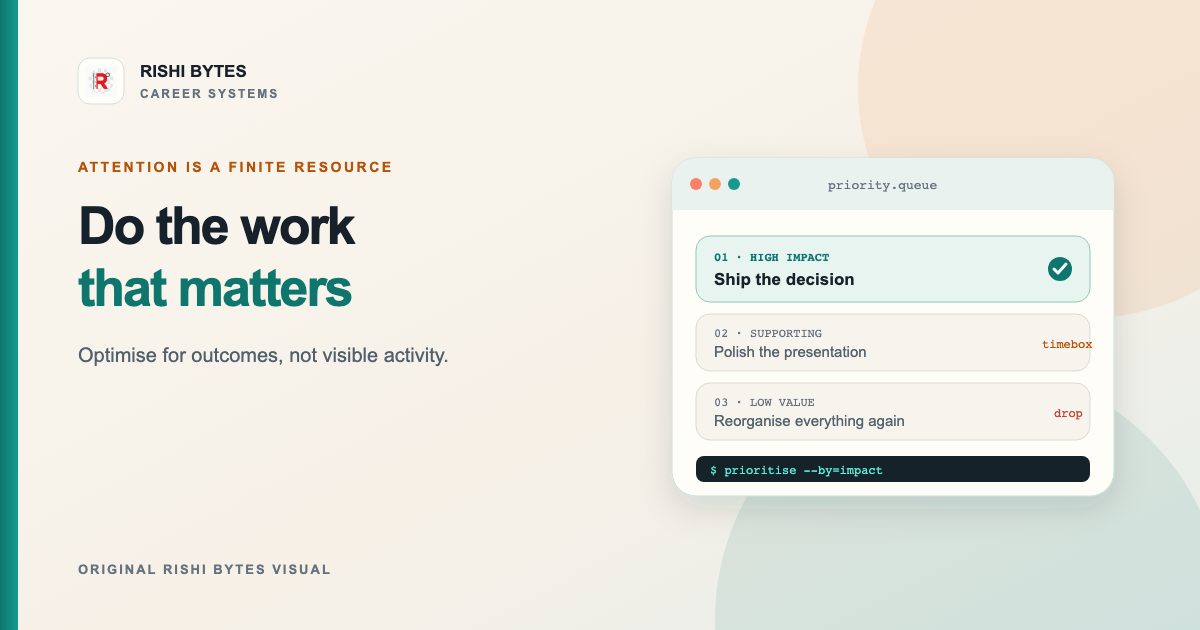
While reading Brian Tracy's Eat That Frog!, one sentence made me stop:
One of the very worst uses of time is to do something very well that need not be done at all.
The problem is not that we lack effort. It is that effort can feel productive even when it is pointed at the wrong thing.
I can remember spending hours perfecting presentations that were not critical, rewriting unimportant messages before pressing send, and reorganising the same material into yet another system. The work looked polished, but the outcome barely changed.
The perfection trap
Low-value tasks are often attractive because they are clear and controllable. Improving a slide, renaming a document, or adjusting a dashboard gives immediate feedback. The difficult work—making a decision, challenging an assumption, or shipping something useful—usually carries more uncertainty.
That creates a dangerous substitution:
We replace important progress with visible activity.
Quality still matters. But quality applied to the wrong task is simply expensive waste.
Three questions before starting
Before investing serious time, I now try to ask:
- What outcome will this task change? If I cannot name the decision, customer, system, or person that benefits, the task may not deserve priority.
- What happens if I do less—or nothing? A small consequence is a signal to reduce the effort, delegate the task, or remove it.
- What does good enough look like? Define the stopping point before perfectionism expands the work.
These questions are especially useful in engineering, where there is always another abstraction to improve, tool to evaluate, or edge case to optimise.
Prioritisation is not neglect
Doing what matters most does not mean ignoring reliability, documentation, or maintenance. Some work has no dramatic visible output but prevents serious future problems.
Security controls, production monitoring, backups, data-quality checks, and incident preparation can be high-impact precisely because the cost of neglecting them is large.
The goal is not to prioritise only urgent or visible work. It is to connect effort to consequences.
A lightweight operating method
A simple approach works better for me than a complicated productivity system:
- Write down the outcome that matters most.
- Select the smallest task that materially advances it.
- Timebox supporting work.
- Stop when the agreed quality bar is met.
- Review what changed—not how busy the day felt.
This also makes it easier to say no. A new request must compete with an explicit outcome rather than being added to an invisible pile.
Spend attention deliberately
Time management is really attention management. We cannot create more attention, but we can stop spending it on work that has little effect.
The next time a task starts expanding, pause and ask:
If I complete this perfectly, what meaningful result will be different?
If the answer is unclear, the best productivity improvement may be to stop.