I Stopped Googling. Is AI Search Actually Honest?
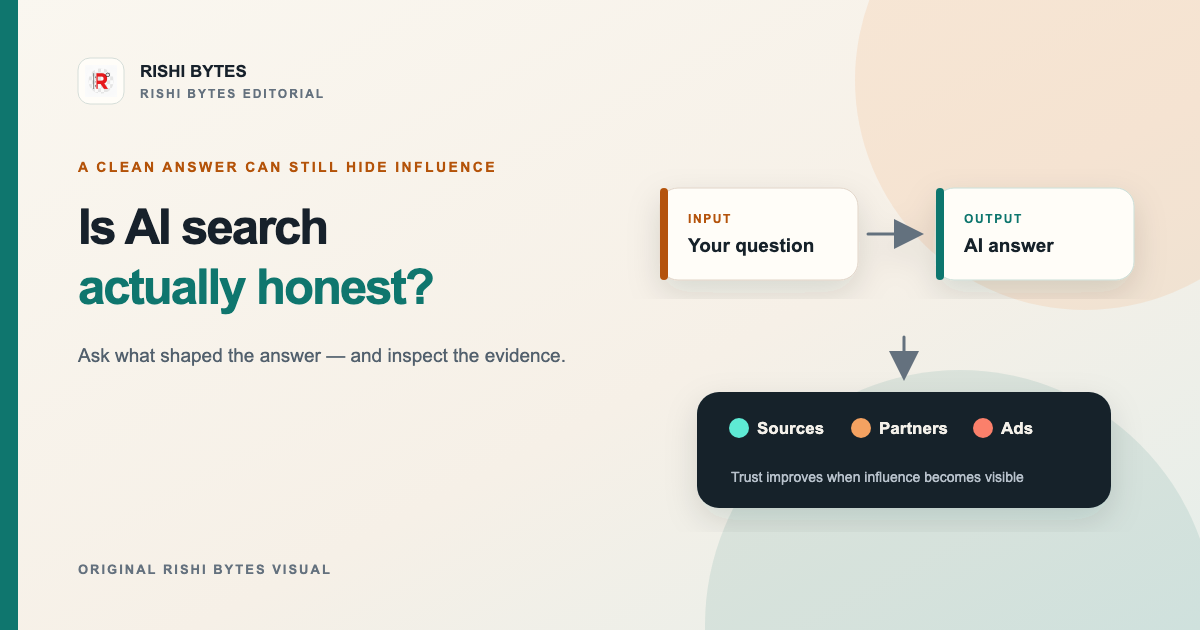
AI answers feel cleaner than search results, but recommendations can still be shaped by training data, commercial integrations, and advertising.
A few weeks before I first wrote this article, I was researching personal liability insurance in Germany — Privathaftpflichtversicherung, because German words like to test your commitment.
Instead of opening Google, I asked Claude. Within seconds I had a clear explanation of what the insurance covers, what to compare, and the typical questions to ask.
No page of advertisements. No ten blue links. No comparison site trying to earn a commission.
Then I realised I was preparing to make a financial decision based almost entirely on an AI-generated answer.
Was the answer neutral, or was something already influencing what I had been shown?
The interface felt cleaner than search. That did not automatically make the information more independent.
Commercial incentives do not disappear
Search advertising became valuable because it reaches people at the moment they are deciding what to buy. If users move some of those decisions from search engines to AI assistants, the commercial demand to influence discovery moves with them.
When I first published this article in March 2026, the approaches were already diverging:
- OpenAI had announced tests of ads in ChatGPT, presented separately from answers for some free users.
- Perplexity had experimented with sponsored questions in 2024 and was later reported to have stopped that test.
- Anthropic had publicly described Claude as a space without advertising.
Those product decisions can change. The broader trust question remains even when no visible advertisement appears.
Three ways an answer can be influenced
1. Training and source bias
Models learn from large collections of human-created material. That material already contains search-optimised articles, public relations, affiliate content, sponsored reviews, and repeated claims.
A company does not need to pay an AI provider directly for its narrative to be overrepresented. Years of publishing and distribution can influence what information is available for models and retrieval systems to learn from.
This is not always deliberate manipulation by the model. It is inherited bias in the information environment.
2. Data partnerships and integrations
Many assistants retrieve current information from external search indexes, product catalogues, travel systems, retailers, or specialist databases.
Those integrations improve freshness and usefulness. They also determine which sources are available, which attributes are exposed, and which providers are missing.
A recommendation can therefore be constrained before the model begins composing the answer.
3. Advertising and sponsored placement
This is the most visible form. A provider may label a sponsored result or place an advertisement near an answer.
Clear labels are better than invisible influence, but they can still affect trust. Once commercial content enters the interface, users need to understand whether it changes only what appears around an answer or what the answer itself recommends.
AI answers create a verification problem
Traditional search results make the source list visible. The ranking may be influenced, but users can usually see which domain they are opening.
An AI answer combines information into a single confident response. Citations help, but many users do not open them. A polished synthesis can make weak evidence feel settled.
The risk is greatest when:
- the decision has financial, medical, legal, or safety consequences;
- the answer recommends a specific product or provider;
- only one source supports the claim;
- prices or policies change frequently;
- the system cannot show where a statement came from; or
- confidence is high while evidence is incomplete.
How I use AI search more carefully
I have not gone back to opening Google for every question. AI search is too useful for exploration, explanation, and narrowing a broad topic.
I now treat the first answer as a starting point:
- Ask for sources and publication dates.
- Open the primary source rather than relying on the summary.
- Separate factual claims from recommendations.
- Compare important recommendations with an independent source.
- Ask what information might be missing.
- Check whether the tool or cited source has a commercial relationship.
- Avoid making high-impact decisions from one generated response.
A cleaner interface is not the same as neutral information
AI search can feel more honest because it removes many of the visible annoyances of web search. That is an interface improvement, not proof of neutrality.
We traded a ranking system we did not fully understand for a synthesis system we may trust too quickly.
The answer is not to reject AI search. It is to demand evidence, disclosure, and the ability to inspect how a recommendation was formed.
Cost is another part of that discipline. More model usage does not automatically create better judgment, as I discuss in Cheap Tokens Won’t Make You a Better Engineer.