ChatGPT Pro 200 Is Getting Less Usage. Will Better Models Make Up for It?
ChatGPT Pro 200 keeps its $200 price but lowers included usage. Why better models, temporary credits, and workload capacity need separate evaluation.
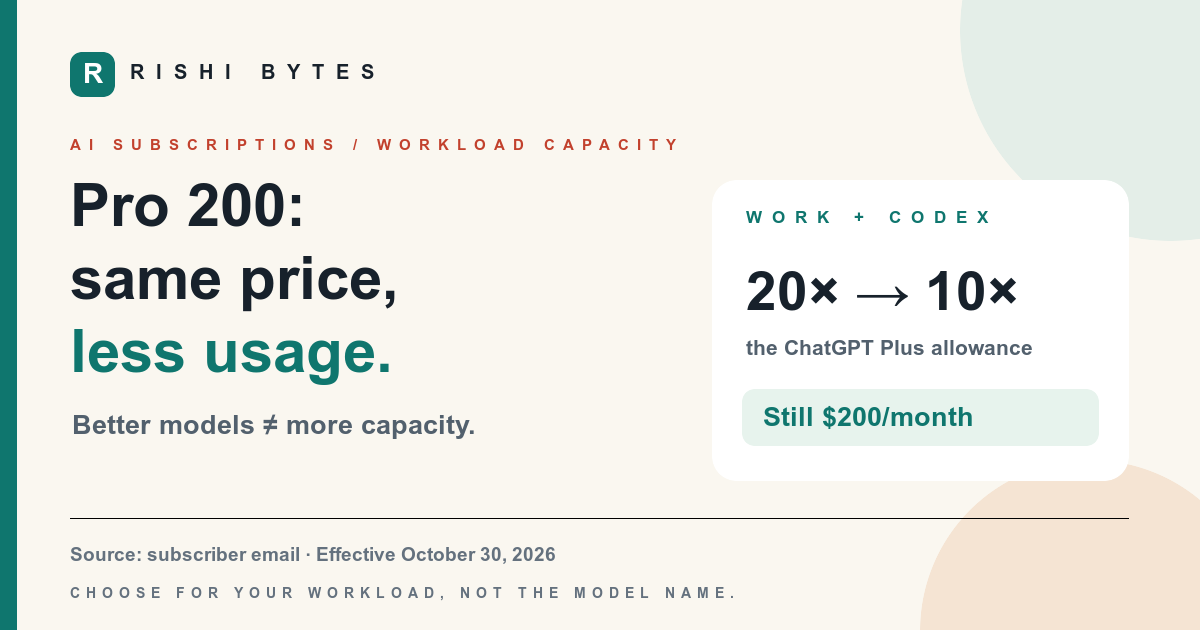
I’m a ChatGPT Pro 200 subscriber, and an email announcing changes to my plan caught my attention.
The message combines two things: better models and less included usage. OpenAI’s argument is that more capable models can help us get more work done with less back-and-forth.
That is a reasonable argument to consider. But it leaves an important question unanswered:
Will the efficiency improvement offset the reduced allowance for my actual workload?
What is changing?
OpenAI’s public Pro-tier documentation says eligible existing Pro 200 subscribers keep their previous allowance through October 29, 2026. After that, they move to a lower allowance. The subscription price remains $200 per month.
The subscriber email I received gives these specifics, effective October 30, 2026:
| Item | Current allowance in the email | Announced allowance |
|---|---|---|
| Included ChatGPT Work and Codex usage | 20× the ChatGPT Plus allowance | 10× the ChatGPT Plus allowance |
| GPT-6 Pro in Chat | 200 messages per week | 100 messages per week |
| Pro 200 subscription price | $200 per month | $200 per month |
Those two stated allowances are being halved. That is not the same as saying every feature of the subscription is being cut by 50%, or that a user's completed work must fall by 50%.
There is also a new Pro 500 tier at $500 per month. The email describes it as including 25× Plus usage and Ultrafast generation. OpenAI’s public documentation confirms the new tier and Ultrafast access.
Another useful detail: the email commits to not reintroducing the five-hour limit, allowing users to spend their weekly allowance when they want. That flexibility matters, even though it does not increase the weekly allowance itself.
The temporary credits deserve a mention
My email also offers a one-time grant of 62,500 usage credits, described as a $2,500 USD value, expiring on December 31, 2026. The offer is subject to service-credit terms.
That is a meaningful transition benefit, not something to leave out of the discussion. However, it is not cash, a permanent increase in the subscription allowance, or evidence that every affected subscriber receives the same offer.
OpenAI’s documentation says credits support eligible features such as Work and Codex; they do not add usage to every ChatGPT model or feature. I would not assume the grant restores the separate GPT-6 Pro Chat message allowance.
For a plan decision, I would evaluate both the short-term position with the grant and the ongoing position after it expires.
Better intelligence and more capacity are different things
The email presents GPT-6.1 Sol as a more capable, efficient model that can reduce back-and-forth. That could improve value: one successful attempt is better than three failed attempts.
But retries are only one source of consumption.
A coding workflow may involve repository exploration, implementation, tests, reviews, and multiple independent tasks. A stronger model might handle each step better without eliminating the need to perform those steps.
The same applies to research or document work. Better answers can reduce corrections, but they do not automatically remove half the projects you need to finish.
Usage is also not simply a token bucket. OpenAI’s Work and Codex documentation notes that allowance consumption can vary with the task, input and output size, reasoning level, and speed setting. Signing in with a ChatGPT subscription and using an API key have different billing arrangements.
So I would not assume either that the new model will perfectly offset the reduction or that it cannot offset it. That is something to measure.
How I would choose a plan
Before the change takes effect, I would track a representative week of work:
- Which features do I use: Chat, Work, Codex, or a combination?
- How much included allowance do I consume, and do I hit limits?
- Does the newer model reduce retries on comparable tasks?
- How many useful deliverables do I complete, and how much human review remains?
- Is faster generation worth paying for in my workflow?
Then I would separate recurring costs from temporary credits and compare plans against that workload.
I would not upgrade just because a higher tier exists. I would also not downgrade purely because the headline allowance is lower. The right choice depends on whether the plan still supports the work I need to complete at a reasonable cost.
My takeaway
Pro 200’s monthly price is not rising in this announcement. Its included allowance is changing, while OpenAI points to better models and offers a temporary credit grant in my subscriber email.
Whether that is better value for me depends on the results—not the model name.
Choose your AI plan by your workload, not by the newest model or the biggest marketing multiplier.
This article reflects the subscriber email I received and OpenAI documentation checked on September 30, 2026. Account-specific offers and product details can change; check your own announcement and usage settings.
Sources
- About ChatGPT Pro tiers — OpenAI
- ChatGPT Work and Codex — OpenAI
- GPT-5.6 and GPT-6 Pro in ChatGPT — OpenAI
- Subscriber email received by the author: exact allowance changes and the account-specific credit offer.